


Webbing
What is Webbing?
Webbing is a strong fabric woven as a flat strip or tube of varying width and fibres, often used in place of rope. It is a versatile component used in climbing, slacklining, furniture manufacturing, automobile safety, auto racing, towing, parachuting, military apparel, load securing, and many other fields.
Why Choose Us
Our Factory
BST is committed to the field of special textile accessories, providing customers with professional, reliable and stable quality products, and providing full supply chain services for textile accessories.
High Quality Product
BST strictly controls every link in production and implements details to ensure that product quality, performance and other indicators meet relevant industry standards, and provide more customers with satisfactory customizable product services.
Customization Service
BST provides personalized customization services, which can be customized according to customer needs in terms of product size, pattern, functionality, etc., and provide one-stop services such as design, proofing, sample delivery, and tracking services.
Sustainable development
BST always implements the concept of combining sustainable development with products. From product design, production, use to recycling, it fully considers environmental protection, resource conservation and other factors to achieve long-term sustainable development of society.


How is Webbing Made?
Webbing products are fabrics which are woven from yarn. The yarn is chosen based on the application of the webbing and is either a natural or synthetic fibre. Natural fibre yarn takes the form of cotton, whilst standard synthetic fibres include polyester, nylon and polypropylene.
The weaving process
Weaving is a method of textile production in which two distinct sets of yarns are interlaced at right angles to form a fabric. The way the warp and weft interlace with each other is called the weave.
The warp is a term for the longitudinal threads and weft is the term used for lateral threads in the weave.
Weave types or patterns are chosen as part of the construction of the product to either meet certain technical requirements, or the aesthetics needed for the end-use application.
Such patterns and weave types include plain, pebble, twill, herringbone, satin and tubular.
At Webbing Products we specifically weave narrow fabrics – which is the manufacture of high-performance webbing that has a narrow width – up to and including 320mm and usually woven with a selvedge (self-finished) edge.
The finishing process
Once weaving is complete, the finishing stage begins. This is where the webbing is dyed, treated with a specialised finish, branded and cut to length.
Dyeing
During this process the woven webbing is dyed to colour match a specific brand or application. The method and equipment used during the dyeing stage can impact the quality of the final product.
Specialised finishes
Specialised finishes are added to the webbing based on the specifications required for its end usage. These finishes,
include flame retardancy, anti-static, Teflon coating, stiffening agent or starches, mould-resistant finishes and water repellent.
Printing and cutting
Printing is added to the webbing for branding and in some cases safety requirements. The webbing is then cut to length as specifications dictate.
Testing and quality control
Webbing is often utilised in diverse safety-critical applications which makes testing and quality control a vital part of the manufacturing process.
High quality webbing products are usually tested against set criteria and should adhere to strict standards as dictated by the final specification and intended use. Testing is done using a variety of methods and machines to examine the quality of the webbing.
Material handling and storage
The final stage of the webbing production process involves packaging, storage and delivery of the final product. It is important that this is done in a systematic fashion to ensure minimum damage is caused to the finished product.
Types of Webbing
For a softer look and more customizability in color, cotton webbing is the perfect choice. Cotton can't hold as much weight as other webbing materials, but it offers a softer natural-fiber look ideal for items like totes, handbags, home décor, belts, and crafts. Plus, it's dyeable! Choose the "natural" color of our cotton webbing to dye this material to the exact hue you want. Finish cut ends on cotton webbing with a simple zigzag stitch to prevent fraying and unraveling.
Polypropylene Webbing is a durable and economical option perfect for everyday objects like tote bags, backpack straps, and bag handles. Though it's not as strong as nylon, Polypropylene Webbing is water-resistant, making it a good choice for objects that might get wet. It features a smooth, shiny finish and excellent colorfastness and is available in medium or heavy weight for use with different fabric weights. Because it consists of synthetic material, you can also conveniently finish the cut edges of this webbing by carefully heating the ends to melt the fibers together.
If your project requires more strength and a bit of flexibility, Nylon Webbing might be the best option. This durable, flexible webbing is ideal for heavy-duty applications, sporting gear and equipment, and projects that need to be able to bear weight. Try Nylon Webbing for items like backpack straps, sporting goods, lanyards, pet collars, leashes, and more. Nylon Webbing absorbs water and has the potential to stretch and weaken when wet for extended periods of time, so it might not be the best choice for all outdoor projects. Like Polypropylene, Nylon Webbing can be finished using heat.
Though similar in its materials to Nylon Webbing, Seatbelt Nylon Webbing has a distinctly different look. Broad and flat, with a smooth finish and flexible feel, Seatbelt webbing has a very high breaking strength and excels where heavy-duty straps are concerned. It's often used in upholstery to reinforce the underside of a seat, or as a seat itself on items like lawn chairs. It's also ideal as a wide strap for projects like messenger bags, luggage straps, and more. Seatbelt Webbing is not intended for seat belt use in motor vehicles or as a safety restraint.
Within the weaving industry at large, webbing falls under the heading of "Narrow Fabrics." Included within this group along with webbing are ribbons, tapes and belting. Webbing is actually two separately woven layers which are bound together in various ways. It is the heaviest form of narrow fabrics, ranging from light straps to monster slings used in heavy lifting.
The following is a partial list of the most commonly used terms in webbing and production.
Back: Usually refers to the underside as the fabric comes off the loom. In patterned webbing, it also refers to the side opposite the primary pattern.
Binders: Yarn which is woven between the front and back to hold the two together, as in flat webbing.
Catch Cord: A yarn which binds the "knitted" needle edge of webbing woven on a needle loom. The catch cord prevents the fill yarn from unraveling at a cut end.
Denier: In general this refers to the size of a yarn. Specifically it is a measure of weight for multifilament yarns. One denier is equal to 1 gram per 9,000 meters.
End: A single yarn or two or more yarns drawn together as one strand.
Fill (weft): The yarn which runs from edge to edge in the webbing. It is carried by a needle or shuttle. Some advanced looms can weave patterns with multiple, colored yarn fills.
Float: Refers to yarn which is not weaving around the fill. In colored patterned webbing, yarn which is not visible on the face is floating in the center. Sometimes floating yarn is used to create patterns on the face.
Front: Usually refers to the top side as the fabric comes off the loom. In patterned webbing it also refers to the side with the primary pattern.
Jacquard: Refers both to a loom and the fabric produced on such a loom. Jacquard looms are able to control the movement of each yarn independently. Originally controlled by an endless belt of punch cards, today's modern looms use computer-controlled magnets.
Ladder Pattern: A distinctive pattern produced in the webbing when alternate ends are different colors.
Needle Loom: A loom in which the fill yarn is carried back and forth by a "needle" which is usually curved. Because the fill yarn is carried from one edge it must be bound to itself on the other, called the needle edge. Complex colored patterns are woven on needle looms.
Pick: This term refers to one pass of the needle or shuttle through the webbing. On the face of a webbing each crosswise or weave is one pick.
Ply: Each woven layer of fabric. Webbing is usually two plies.
Selvage: The non-raveling edges of fabric. In patterned webbing, it is the area on each side of the colored pattern area.
Shuttle Loom: A loom on which a spool of fill yarn is carried from edge to edge in a shuttle. The fill yarn forms a continuous "spiral" along the webbing. Normally only ladder type patterns can be produced.
Warp: The yarns running lengthwise in webbing. Normally these are the yarns which are manipulated to produce a pattern.
Flat Webbing vs. Tubular Webbing: Which One Is Right for You?
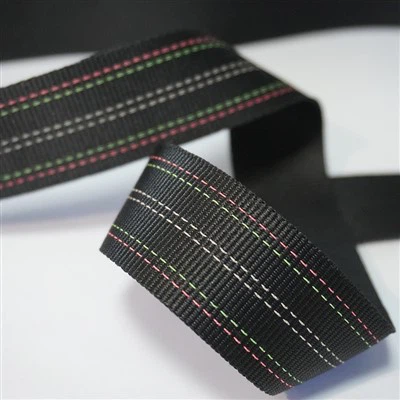


Flat Webbing: An Overview
When you think of webbing, flat webbing might be the first thing that pops into your mind. And there's a good reason for that.
Imagine a flat rope, but with superpowers. That's flat webbing for you. Its flat nature gives it a wide surface area, making it less likely to dig into objects (or people) and distribute weight evenly.
You've probably encountered flat webbing more times than you realize:
Seat belts: That snug belt keeping you safe during your drives? Thank flat webbing.
Backpack straps: Those comfortable straps that don't dig into your shoulders? Again, the magic of flat webbing.
Furniture manufacturing: From sofas to chairs, flat webbing provides the underlying support.
Pros:
Durable: It can take a beating and still hold strong.
Versatile: Its flat design makes it suitable for various applications.
Secure: Its wide surface area ensures loads are set securely.
Tubular Webbing: An Overview
If flat webbing is the versatile all-rounder, tubular webbing is the specialized expert, especially when things get tough.
Tubular webbing is essentially a tube of nylon webbing. It's bulkier than its flat counterpart, but don't let that fool you. Inside that tubular design is a world of strength and resilience. It's designed to be strong, flexible, and incredibly durable.
Here's where tubular webbing shines:
Climbing ropes: Need something that can handle the strain and stress of climbing? Tubular webbing is your go-to.
Industrial applications: From slings to harnesses, its strength is unmatched.
Rescue operations: When lives are on the line, the rescue teams trust tubular webbing.
Pros:
High tensile strength: It's built to handle heavy loads.
Flexible: Its tubular nature allows for a bit more give, making it adaptable.
Abrasion-resistant: This webbing can resist wear and tear like a champ.
Comparative Analysis: Flat vs. Tubular
In the webbing world, there's a classic showdown: flat nylon webbing vs. tubular nylon webbing. It's like comparing apples to oranges—both are fruits, but they offer distinct flavors.
Strength and Durability
Both types boast a high tensile strength, but there are nuances. Tubular nylon webbing, often used in climbing ropes, is designed to handle extreme loads. Its construction makes it resistant to abrasions and wear. On the other hand, flat nylon webbing is the go-to for applications like cargo straps, where even weight distribution is key.
Flexibility and Stretch
When you think of flat nylon webbing, picture it as the versatile flat rope in the webbing world. It's got that extra stretch, perfect for tasks that need a touch of flexibility. On the flip side, tubular nylon webbing stands out with its distinct tubular shape. It strikes a balance between being bendy and firm, which is why those who climb rope swear by it.
Resistance to Environmental Factors
Both types are champions when it comes to resisting environmental foes. Nylon webbing, in general, offers resistance to moisture and UV rays. However, a note of caution: prolonged exposure can still degrade the material over time, so it's essential to consider the environment in which it'll be used.
Cost-effectiveness
Price can be a deciding factor. While specific prices can vary based on width, length, and brand (shoutout to SGT Knots for their quality offerings), tubular nylon webbing tends to be pricier due to its specialized applications. Flat nylon webbing, sold often by the foot or on a spool, can be more budget-friendly, especially when bought in bulk.
Factors to Consider When Choosing Webbing
With a sea of webbing options in various colors and types, how do you pick the right one? Here's a guide to help you navigate:
Intended Use or Application
First things first, what's the job? If you're looking to untie knots frequently, you might lean towards flat nylon for its stretch. But if you're into mountain adventures, a climbing rope made of tubular nylon webbing might be your best bet.
Budget Constraints
Let's talk money. While both types offer great value, your budget might lean towards flat nylon webbing, especially if you're eyeing bulk purchases. Don't forget to check the cart for any deals or discounts!
Longevity and Maintenance
Both types are built to last, but remember; nylon can degrade with prolonged exposure to harsh elements. Regular reviews and checks can ensure your webbing stays in top shape.
Safety Requirements
Safety first! Whether it's mil-spec standards for military applications or ensuring your cargo straps hold firm on the highway, always ensure the webbing you choose meets the necessary safety standards.
Our Factory
Changxing Bst Textile Co., Ltd. is located in Huzhou City, Zhejiang Province. The company specializes in the research and development, production and sales of textile accessories, and is committed to the field of special functional textile accessories. We have advanced production equipment and process technology, adhering to the business philosophy of quality priority, customer foremost, focus on innovation, integrity management, and win-win cooperation, and we will integrate sustainable development throughout the entire life cycle of the product, provide customers with safe and reliable high-quality products and personalized customization services, and provide full supply chain services for textile accessories.


FAQ
As one of the leading webbing manufacturers and suppliers in China, we warmly welcome you to wholesale custom made webbing from our factory. Contact us for more cheap products.
1 2 inch cotton webbing, 1 2 cotton webbing, cotton strapping