


Braided Rope
What is Braided Rope?
Braided rope is a rope made by weaving strands of fiber together into a tube-like braid. The process of braiding creates a rope that is strong, smooth, and resistant to tangling and kinking.
Why Choose Us
Our Factory
BST is committed to the field of special textile accessories, providing customers with professional, reliable and stable quality products, and providing full supply chain services for textile accessories.
High Quality Product
BST strictly controls every link in production and implements details to ensure that product quality, performance and other indicators meet relevant industry standards, and provide more customers with satisfactory customizable product services.
Customization Service
BST provides personalized customization services, which can be customized according to customer needs in terms of product size, pattern, functionality, etc., and provide one-stop services such as design, proofing, sample delivery, and tracking services.
Sustainable development
BST always implements the concept of combining sustainable development with products. From product design, production, use to recycling, it fully considers environmental protection, resource conservation and other factors to achieve long-term sustainable development of society.


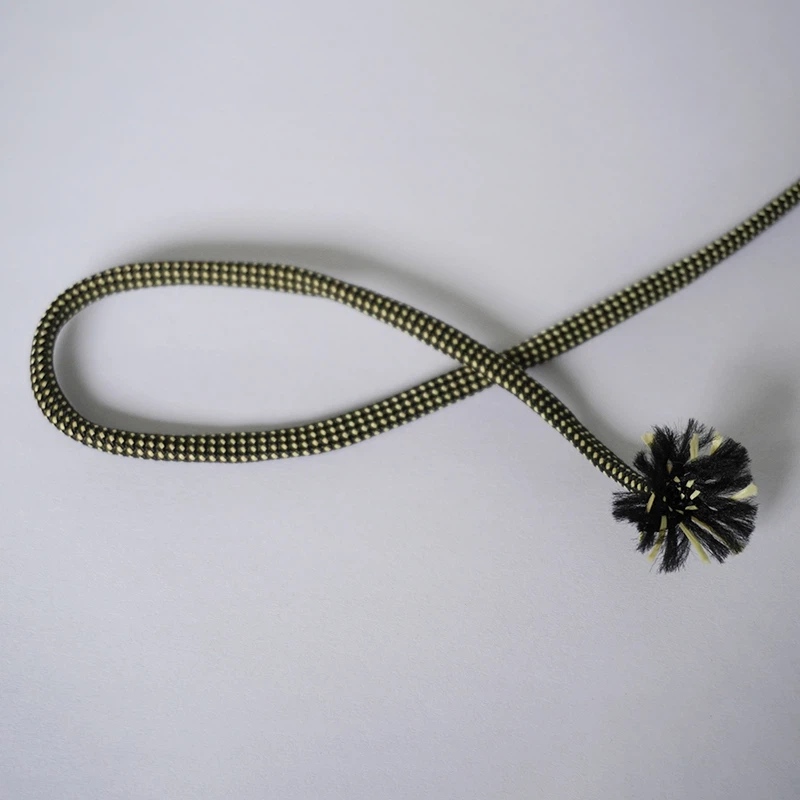
Braided rope comes in several varieties:
Single braid. Consists of 8 or 12 strands that are braided together in a circular pattern. One-half of the strands go clockwise, the other half go counter-clockwise. It creates a tubular-shaped rope.
Double braid. Also known as a "braid on braid" or "marine rope." It has a braided core with a braided sheath around the core. It's basically a rope within a rope. The inner and outer rope both provide strength in bearing load. It's a strong, durable rope that's resistant to abrasion and doesn't easily kink. It also holds its shape really well. It's used on boats quite a bit.
Kernmantle. Similar to a double-braid rope, but instead of the inner core being braided, the strands in the inner core are either twisted or simply run parallel together. The outer layer is tightly braided, giving it higher abrasion resistance. Kernmantle is actually German for "core" (kern) and "sheath" (mantle).
What is Braided Rope Used For?
Braided rope, whether it's single strand or multi-strand, is widely known as the most durable rope. The braid craft reduces the stretch pressure of the rope and makes it thicker, ideal for many daily applications.
Uses of Braided Rope
The Braided Rope can be utilized in both industrial and non-industrial uses. Here are some applications that we apply the braided ropes in our daily life:
1. Towing Vehicles
Braided ropes are perfect tools for towing, heavy duty lifting and hauling. With unmatched resistance and protection from rot, these ropes are adaptable in tough environments and weather conditions. If you always drive far from home or travel everywhere on roads, it is necessary to keep strong braided rope in your car.
2. Wokout Recreation
If you are keen on workout, sports and recreation with kids, then braided ropes and cords are definitely helpful for you! The polypropylene material is anti-UV light and durable which helps them from fading when used outdoors, ideal for fixing up swings, hammocks, hunting, camping, backpacking, and other outdoor trips.
3. Decoration Crafts
Ropes made of sisal, manila and cotton are great for crafting and decorative purpose. They have low moderate stretch , commonly adopted for weaving, decoration, or putting together jewelry, DIY crafts, rugs etc. The skilled crafters can use them to create the perfect piece.
4. Pets, Colthline and Nets
A braided rope made from any material be it natural fibers, sisal or nylon would be perfect to take your pet dog for a walk. They come in some very attractive colors. The ropes are constructed using natural materials without harmful chemicals and plastic fibers. Moreover, they are also widely uesd for colthline and nets with fashionable style and colors to choose from.
Difference Between Braided and Twisted Rope
Rope is fibers, yarns, plies, or strands that are grouped together and twisted or braided to become stronger and larger. Ropes have many uses but are commonly used for dragging or lifting because of their thickness compared to cord, string, or twine. The two most common forms of rope are braided and twisted. Although they can sometimes be used for similar purposes, they have distinct pros and cons and have different strength capabilities.
Braided
Braided rope is created by braiding together 8-10 fibers into a tube-like braid. Polypropylene and nylon are the two most common forms of material used. There are three types of braided rope:
The first is Hollow Braided Rope, which is created by braiding groups of fibers together to create a tight tube of rope with an empty center.
The second is Solid Braid Rope, which is a complex braid that has a filler core which gives it more strength than a Hollow Braided Rope.
The third is a Double Braided Rope. This kind of rope has a braided core that is covered with a braided jacket. This braided core allows it to be even stronger than the Solid Braid Rope.
Although these braided ropes have small differences, they have similar pros and cons.
Check out the list below.
More flexible
Stronger than twisted
Smoother feel for touch
Pros
Difficult to splice
Less stretch than twisted
Twisted
Twisted rope is created by taking fibers and twisting them into strands, and then twisting the strands into rope. Three-strand twisted rope is the most common form of construction, and it can be made of nylon, polyester, polyethylene terephthalate, and polypropylene.
Check out twisted rope's pros and cons below.
Easy to splice
Less expensive
More stretch than braided
Better for the outdoor
Pros
Tends to kink
Less flexible
Strands can separate if not sealed off
How is Braided Nylon Rope Made?
Rope is a combination of yarns, cord layers, fibers or strands that are combined to form a stronger and safer form.
There are two main types of rope: stranded rope and braided rope. Stranded ropes usually have tensile strength, so they can be used for towing, lifting, climbing, and even fishing; but are too flexible to provide compressive strength. Braided rope is usually thicker and stronger than similarly constructed thin rope and twine. Rope can be made from different materials, from natural to man-made, such as nylon and polyester. But that's another story. In this article, we will show you the different methods used to produce nylon braided rope.
Nylon is a man-made (or synthetic) material. So, in this step, several filaments are combined in a process called doubling or throwing. This produces strips of multi-layered filaments.
Obviously, nylon braided ropes are made of synthetic materials. The spools of yarn are set on pairs of moving pendants on the braiding machine. Each pendant moves in an oscillating pattern, weaving the yarn into a tight braid. A set of rollers pulls the braid through the rails to lock or hold the braid in place and keep the tension on the cord. In some machines, the braiding process is accomplished by feeding the yarn into a separate, counter-rotating register plate. One yarn is braided in one direction, then another yarn is braided in the opposite direction, and so on, creating an interlocking braid.
As the rope comes out of the rollers, it is wound on a spool. The finished loop is then removed and prohibited and the ends are taped or melted.
The level of quality control depends on the intended use of the rope.
Ropes for general use are mainly supplied by diameter and tensile strength. Tensile strength is determined by breaking sample pieces under load. Basic raw material specifications and visual inspection are the only quality control measures used for these ropes.
Ropes used for high-risk applications, such as rescue construction and lifting heavy loads — require more careful inspection and testing. These ropes may have code colors for easy tracking by the user.
Nylon is a tough, lightweight and flexible man-made polymer with a protein-like chemical structure. Nylon fiber is a well-known material in the rope manufacturing industry. But is braided or twisted rope better than nylon? The answer is both. Both braided and twisted ropes have very different structures and strengths. Which is better depends on your intended use.
How to Identify Quality in Braided Rope


Sighting the Braid
When selecting a new piece of line, simply sight down its length as you would a plank. If you see broken yarn filaments, high or low strands, corkscrew or roll, randomly uneven yarn color or looped strands; beware!
Broken Yarn Filaments
This indicates the use of poorly maintained machinery or lack of yarn finish. This defect will result in lower strength (because a portion of the rope is already broken), greater stretch, premature wear and more rapid degradation.
High or Low Strands
The presence of this defect reveals uneven yarn tensioning in manufacture or use of different yarn sizes. It means that some of the yarns will not be sharing the work equally with the others' resulting in more stretch at a given load, lower ultimate break strength and more rapid wear.
Looped Strands
This defect is usually caused by unequal yarn tensioning in the manufacturing process and results in the same problems as mentioned above.
Corkscrew or Roll
This occurs when the tensions of the yarn in one direction are different from the tensions of the yarn in the other direction. It can also be caused by the use of dissimilar yarns, which have differing shrink or stretch characteristics. One major problem with the presence of this defect is that the line may tend to accept of resist (depending on the direction of the roll) the temporary twist, which is induced in sheets when they are peeled from the top of a winch. If the line doesn't properly accept twist in this application it will tend to hockle and jam in blocks more frequently.
Randomly Uneven Yarn Color or Sheen
This is a dead give-away to the use of inferior, odd lot yarns of various types and finished that are likely to result in a variety of problems including uneven wear and premature failure.
Strands Twist
All braided ropes should be constructed using clockwise and counter-clockwise twisted strands (referred to as "S" twist and "Z" twist in the trade). The reason for this design is to orient all of the fine yarn filaments parallel to the longitudinal axis of the rope allowing them to be combed rather than plucked, snagged and broken when dragged over a rough surface as they would be if they were at an angle or perpendicular to the axis of the rope.
Finished Warns
Raw yarn can be purchased from a producer with "finish or, for a little less cost, without a "finish". Finish is the trade name for lubricant that is etched or chemically bonded to the yarn, which dramatically improves its performance. The wet performance of a rope made with Seaguard® finish, for example, can out perform an unfinished rope by as much as 20 times.
Properly Sized Rope
It is important for a rope to maintain the proper size while under load. Undersized rope presents less surface area to winch and sheave surfaces thereby requiring less yarn to bear more load. Undersized rope may require more wraps to develop the same holding power on a winch. This is especially true when the rope is wet or used in self-tailers. Undersize rope may perform poorly in various cam cleats and halyard stoppers. Check the weight per foot specifications to compare sizes of ropes made with similar materials.
Spliceability
It is sometimes difficult for the layperson and experienced rigger alike to determine if a rope will be properly spliceable without actually performing the task. A high quality rope is engineered to accomplish a balance of purpose between the double braided cover and core, resulting in uniform spliceability whether the rope is new or used. One simple test, which may indicate an imbalance between cover and core, is to coil the rope. If it does not coil uniformly, bends more sharply in some places or resists coiling altogether, you should question the rope's quality.
Braider Splices
Some manufacturers use undersize braiders to produce rope. While smaller braiders may run faster and are less expensive to buy, rope produced on them will contain many yarn and strand splices in a given length. Splices can sometimes be seen in the cover strands, but are hidden in the core. Premium quality rope, like Yale Cordage, New England Rope, and Samson do not allow braider splices in the core or cover of 600-foot spools.
Cleanliness
There is no reason to accept rope from a manufacturer with grease or oil spots. While it may no seriously affect performance, it is an indication of lack of commitment of quality and inspection.
Our Factory
Changxing Bst Textile Co., Ltd. is located in Huzhou City, Zhejiang Province. The company specializes in the research and development, production and sales of textile accessories, and is committed to the field of special functional textile accessories. We have advanced production equipment and process technology, adhering to the business philosophy of quality priority, customer foremost, focus on innovation, integrity management, and win-win cooperation, and we will integrate sustainable development throughout the entire life cycle of the product, provide customers with safe and reliable high-quality products and personalized customization services, and provide full supply chain services for textile accessories.


FAQ
As one of the leading braided rope manufacturers and suppliers in China, we warmly welcome you to wholesale custom made braided rope from our factory. Contact us for more cheap products.