


Self-luminous Webbing
What is Self-luminous Webbing?
The luminous webbing inherits the permanent light-emitting properties of the luminous fiber, and absorbs the light and does not require any energy drive. It is an excellent choice for outdoor safety protection.
Why Choose Us
Our Factory
BST is committed to the field of special textile accessories, providing customers with professional, reliable and stable quality products, and providing full supply chain services for textile accessories.
High Quality Product
BST strictly controls every link in production and implements details to ensure that product quality, performance and other indicators meet relevant industry standards, and provide more customers with satisfactory customizable product services.
Customization Service
BST provides personalized customization services, which can be customized according to customer needs in terms of product size, pattern, functionality, etc., and provide one-stop services such as design, proofing, sample delivery, and tracking services.
Sustainable development
BST always implements the concept of combining sustainable development with products. From product design, production, use to recycling, it fully considers environmental protection, resource conservation and other factors to achieve long-term sustainable development of society.


The process of making glow-in-the-dark webbing involves treating the webbing material with a special phosphorescent pigment that is capable of absorbing and storing light energy. This pigment is typically applied to the surface of the webbing material in a liquid form, using a variety of application methods, such as spraying, dipping, or screen printing. The treated webbing is then exposed to a source of light, such as sunlight or artificial light, for a period of time to allow the pigment to absorb the light energy. Once charged, the webbing will glow in the dark for several hours, depending on the intensity of the initial light source and the quality of the pigment used.
Glow-in-the-dark webbing offers a number of benefits for manufacturers who are looking to add a unique and eye-catching feature to their products. Here are some of the key benefits:
Enhanced Safety: Glow-in-the-dark webbing can enhance the safety of a wide range of products, such as backpacks, dog collars and leashes, and safety vests. By emitting light in the dark, these products are more visible to others, reducing the risk of accidents or collisions.
Customizable: Glow-in-the-dark webbing can be customized to meet the specific needs of a manufacturer's products. You can print your logo on the webbing.
Eye-Catching Feature: Glow-in-the-dark webbing is a unique and eye-catching feature that can help products stand out in a crowded market. This can be especially beneficial for manufacturers who are looking to differentiate their products from competitors.
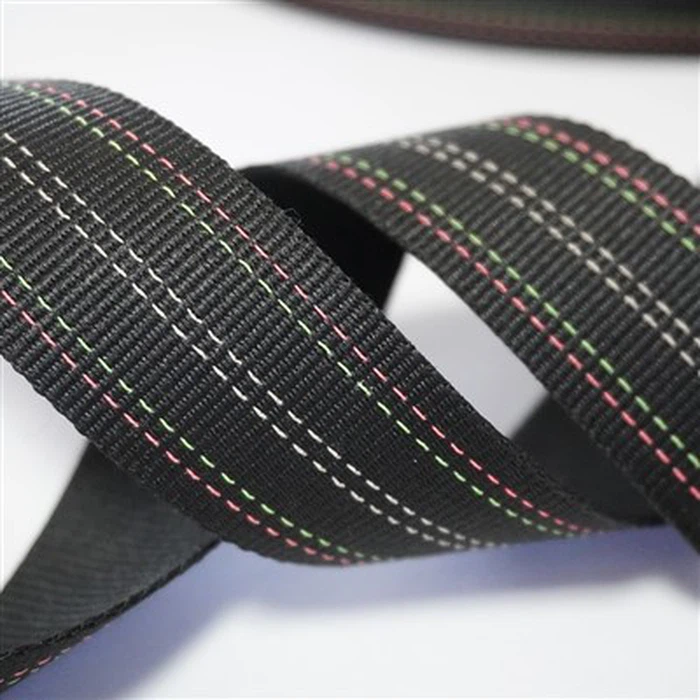
Webbing can be either tubular webbing or flat webbing. Flat webbing is a solid weave of the fabric. It's often used for straps on bags and backpacks. Tubular means that the webbing is woven in the shape of a tube then flattened to offer double layers. Tubular webbing has many safety applications for kayaking, anchor climbing, and camping.
There are many types of fabrics used for webbing tape. These fabrics include canvas, acrylic, nylon, polypropylene, polyester, and cotton twill. The type you use will depend on your specific application. We have many tape and marine webbing products available for you in a variety of widths, colors, thicknesses, and materials.
About The Color Fastness of The Webbing
Color fastness is one of the important quality indexes of textiles. The so-called color fastness refers to the degree to which the color of dyed textiles remains firm under the physical and chemical action, that is, the degree of fastness to the color of dyed textiles affected by the outside world is called the color fastness. The color fastness is indicated by the color change of the sample after the test and the rating of the degree of white cloth staining.
Among various items of color fastness, the most commonly used color fastness include color fastness to friction, to perspiration, to washing, to light, to water, to scrubbing, to weather, etc. In actual life, the final use of products is mainly determined to determine which items to examine, among which the color fastness to sweat, dry friction and water immersion are required by the basic safety technical specifications of textiles, and all dyed textiles should be examined. In addition, textile products for infants and children should be tested for color fastness to saliva.
The evaluation of color fastness generally adopts the visual evaluation method, that is, the gray sample card as the standard sample, under certain lighting and environmental conditions, the human eyes compared the gray card and the sample, in order to determine the sample discoloration and white cloth staining level. Grey cards (for discoloration and staining, respectively) are rated in five levels of fastness, namely 5, 4, 3, 2, 1. Level 5 is best and level 1 is worst. In every two levels, another half level is added, namely 4, 5, 3, 4, 2, 3, 1, 2, so our daily grey card is grade 5 and grade 9, and the dyeing fastness evaluation result is one of the 9 levels. If the ribbon product of a certain color fastness does not reach the standard level, then the ribbon product is unqualified.
How Choosing Between Polypropylene And Nylon Webbing
Webbing is commonly used because of how strong a fabric it is. It is used for a wide array of different applications between home, commercial, and art. Webbing is made in many different materials, but of all of them, polyester and polypropylene are amongst the most commonly used. Because of all their benefits, both types are often used for commercial and industrial applications.nylon webbing
Knowing the difference between both materials, meaning their advantages and disadvantages, will make it easier to make a smart decision while shopping.
Color options
Nylon is limited to neon and basic colors, whereas polyester is available in vibrant patterns because of sublimation. If you are concerned with how your wire rope looks, consider polypropylene.
01
UV protection
Nylon, when left out in the sun for too long, will begin to fade and look dull. Polypropylene is resistant to bleeding and retains its colors more vibrantly.
02
Strength
Both types of webbing are strong, but polypropylene is less strong when compared to nylon. If high strength is required, nylon webbing is your best option.
03
Marine Environments
Polypropylene floats in water, and so it makes a great tie down. Nylon webbing is weak when wet and can also stretch. When wet, polyester webbing is very strong.
04
Durability
Nylon is the more durable of the two materials. Polypropylene and polyester webbing are similar to nylon, but they are lighter than nylon.
05
Our Factory
Changxing Bst Textile Co., Ltd. is located in Huzhou City, Zhejiang Province. The company specializes in the research and development, production and sales of textile accessories, and is committed to the field of special functional textile accessories. We have advanced production equipment and process technology, adhering to the business philosophy of quality priority, customer foremost, focus on innovation, integrity management, and win-win cooperation, and we will integrate sustainable development throughout the entire life cycle of the product, provide customers with safe and reliable high-quality products and personalized customization services, and provide full supply chain services for textile accessories.


FAQ
As one of the leading self-luminous webbing manufacturers and suppliers in China, we warmly welcome you to wholesale custom made self-luminous webbing from our factory. Contact us for more cheap products.
glow in the dark webbing, glow in the dark tape, White Self luminous Webbing