


Hey there! As a flat rope supplier, I often get asked a bunch of questions about our products. One question that pops up quite a bit is, "Do flat ropes have a high friction coefficient?" Well, let's dive right into this topic and find out.

First off, let's understand what the friction coefficient is. In simple terms, the friction coefficient is a measure of how much resistance there is when one surface slides over another. A high friction coefficient means there's a lot of resistance, while a low one means things can slide more easily.
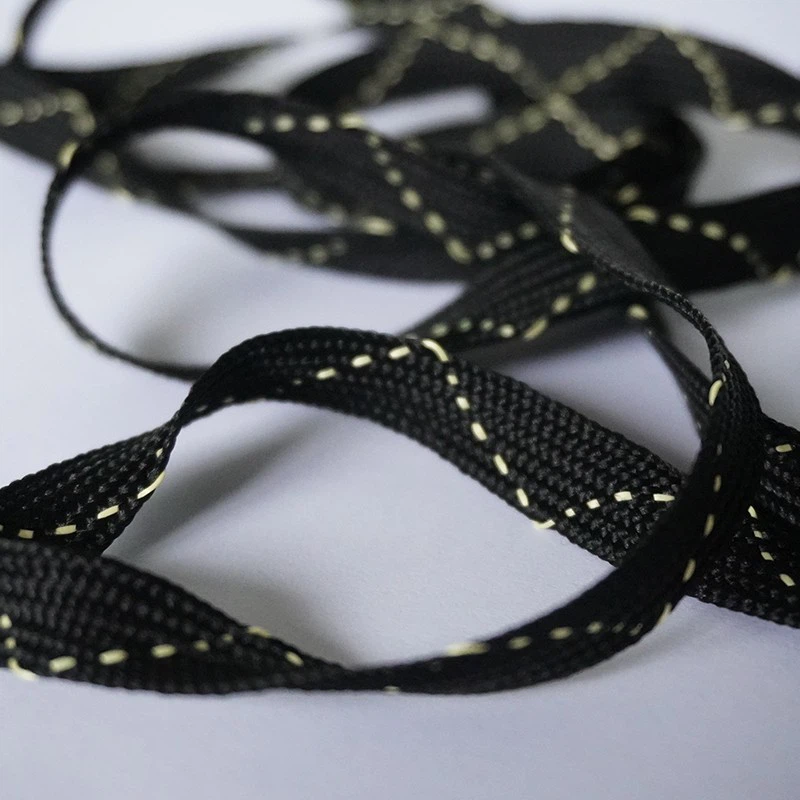
Now, when it comes to flat ropes, the friction coefficient can vary depending on several factors. One of the main factors is the material the rope is made from. We offer different types of flat ropes, like the Aramid Pattern Rope, Polyester Rope, and Nylon Rope. Each of these materials has its own unique properties that affect the friction coefficient.
Aramid is a high - performance synthetic fiber. It's known for its strength and heat resistance. Aramid pattern ropes usually have a relatively high friction coefficient. This is because the surface of aramid fibers has a certain roughness at the microscopic level. When the rope comes into contact with another surface, these tiny bumps and irregularities create more points of contact, increasing the frictional force. This high friction can be really useful in applications where you need the rope to grip onto something firmly, like in climbing or in some industrial lifting operations.
Polyester ropes, on the other hand, have a different story. Polyester is a smooth and durable material. It generally has a lower friction coefficient compared to aramid. The smooth surface of polyester fibers allows for less resistance when the rope slides over other surfaces. This can be an advantage in applications where you need the rope to move freely, such as in some types of pulley systems. However, in situations where you need a good grip, the lower friction might be a drawback.
Nylon ropes are somewhere in between. Nylon is a strong and elastic material. It has a moderate friction coefficient. The elasticity of nylon can also play a role in how it interacts with other surfaces. When a nylon rope is under tension, it can conform to the shape of the surface it's in contact with, which can increase the contact area and thus the frictional force to some extent.
Another factor that affects the friction coefficient of flat ropes is the surface finish. If a flat rope has a rough finish, it will have a higher friction coefficient compared to a rope with a smooth finish. We can control the surface finish during the manufacturing process. For example, we can add some texturing to the rope to increase its friction if that's what the customer needs.
The environment in which the rope is used also matters. In wet conditions, the friction coefficient of most ropes can change. Water can act as a lubricant, reducing the friction between the rope and the contact surface. For example, a polyester rope that has a relatively low friction coefficient in dry conditions might become even more slippery when wet. On the other hand, some ropes are treated to be more water - resistant and maintain their friction properties better in wet environments.
The load on the rope is yet another factor. When a heavier load is applied to a flat rope, the normal force between the rope and the contact surface increases. According to the laws of friction, the frictional force is proportional to the normal force. So, with a higher load, the frictional force and thus the effective friction coefficient can increase.
Let's talk about some real - world applications. In the marine industry, flat ropes are used for mooring boats. Here, a high friction coefficient can be crucial. A rope with a high friction can grip the mooring cleats or bollards more securely, preventing the boat from drifting away. In this case, an aramid or nylon rope might be a good choice.
In the field of rock climbing, climbers rely on ropes with a high friction coefficient to ensure their safety. When a climber is rappelling or belaying, the rope needs to grip the climbing equipment firmly. Aramid ropes are often used in high - end climbing gear because of their high friction and strength.
In the textile and manufacturing industry, flat ropes are used in conveyor systems. Here, a low friction coefficient might be preferred. Polyester ropes can be a great option as they allow for smooth movement of the conveyor belts, reducing wear and tear on the equipment.
As a flat rope supplier, we understand that different customers have different needs. Whether you need a rope with a high friction coefficient for a specific application or a low - friction one, we can provide you with the right product. We have a team of experts who can help you choose the most suitable rope based on your requirements.
If you're in the market for flat ropes and want to discuss your specific needs, we'd love to hear from you. We can offer you detailed information about the friction coefficients of our different ropes and how they can perform in your applications. Whether it's for industrial use, sports, or any other purpose, we've got the ropes to meet your needs.
So, if you're interested in learning more or placing an order, don't hesitate to reach out. We're here to make sure you get the best flat ropes for your projects.
References
- "Engineering Mechanics: Statics and Dynamics" by R.C. Hibbeler
- "Materials Science and Engineering: An Introduction" by William D. Callister, Jr. and David G. Rethwisch